


Table of Contents
- Why Accurate Measurement Matters for Lingerie Fit
- How to Measure Bust with a Piece of String
- Measuring Your Underbust and Band Size
- Finding Cup Size Without a Tape Measure
- Signs Your Bra Is the Wrong Size
- Alternative Methods When String Isn't Practical
- Converting Your Measurements to Your Size
- Conclusion
- Frequently Asked Questions
Last Updated: 4 September 2026
Finding your correct lingerie size often feels impossible when you don't own a fabric tape measure, but learning how to measure for lingerie without tape is simpler than most people think. You likely have everything you need at home already, from a piece of string to a standard ruler. At Dressed 2 Digress, we know that accurate measurements are the foundation of a confident fit, especially when you are shopping for inclusive sizes that are graded on real bodies rather than scaled-up versions of smaller frames.
The trick is that bra fitting depends on two key measurements: your underbust and your fullest bust. Once you capture these figures, you can translate them into a band size and cup volume with confidence. Below, we will show you exactly how to take these measurements using household items, how to convert them into your UK size, and what to do when string simply isn’t practical.
Why Accurate Measurement Matters for Lingerie Fit
Most fit problems trace back to a single cause: wearing a band that is too loose and a cup that is too small to compensate. A bra that fits correctly should get its primary support from the band, with the straps simply keeping it in place — a principle confirmed by breast-health researchers at the University of Portsmouth, the leading academic group studying bra fit and breast biomechanics. When you measure accurately, you stop guessing and start choosing pieces that actually support you.
This matters even more when you are buying extended sizes. Many brands grade larger sizes by simply stretching a smaller pattern, which leads to straps that dig in and cups that gap. Properly measuring your body first means you can identify brands that use considered sizing graded on real bodies, ensuring the structure of the garment matches your actual shape rather than an approximation of it.
How to Measure Bust with a Piece of String
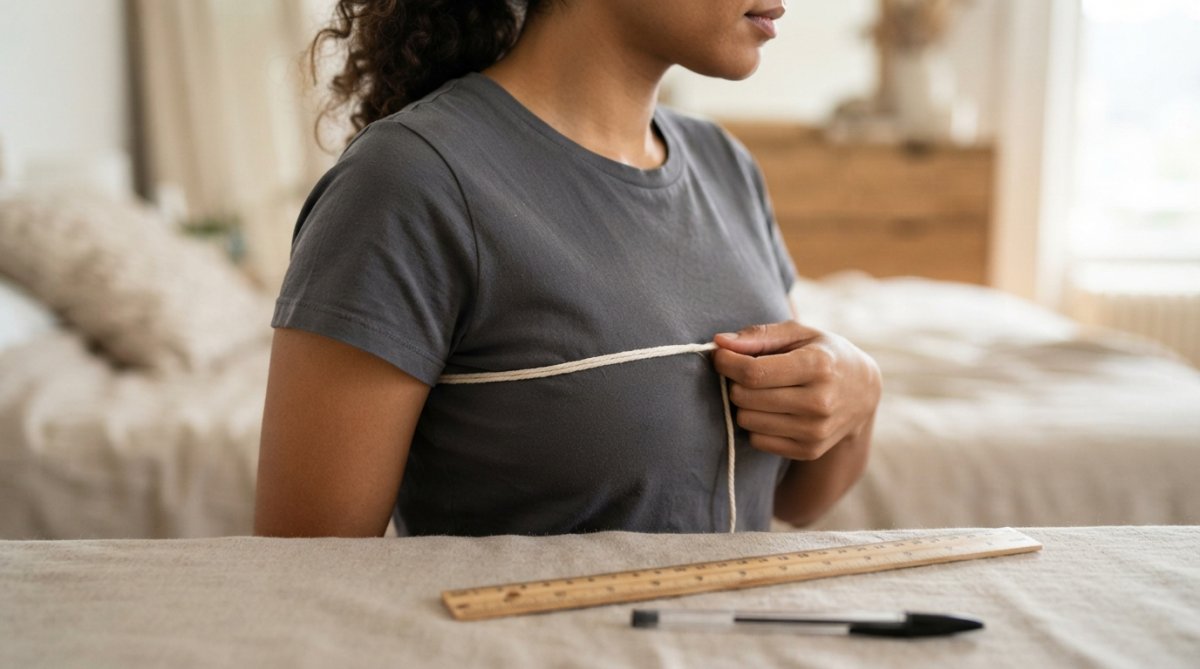
Measuring your bust without a tape measure is a straightforward process that takes about two minutes. You will need a piece of string that does not stretch, a ruler, a pen, and a mirror. Avoid using elastic or ribbon, as stretchy materials will give you an inflated number that throws off your entire size calculation.
Preparing Your String and Gathering Tools
Stand in front of a mirror wearing your best-fitting, non-padded bra, or no bra if that feels more accurate for your shape. Hold one end of the string at the centre of your chest, right where a bra wire would sit. Keep the string level and flat against your skin, ensuring it does not twist or dig into your flesh.
Taking Your Bust Measurement
Wrap the string around your back and bring it to the fullest part of your bust, usually in line with your nipples. The string should feel snug but never tight enough to compress your breast tissue. Mark the point where the string overlaps with your pen, then lay the string flat against a ruler to record the length in centimetres.
Measuring Your Underbust and Band Size
Your band size is determined by the measurement of your ribcage, taken directly under your bust. Using the same piece of string, wrap it around your torso so it sits exactly where the bottom band of a bra would rest. Ensure the string is horizontal all the way around your back, as a drooping line here will add extra centimetres.
Pull the string until it feels comfortably firm, mimicking how you want a bra band to feel: secure enough to stay put but not so tight that it leaves marks. Mark the overlap and measure it against your ruler. In the UK, this number in centimetres is then converted to your band size, which we will cover in the conversion section below.
Finding Cup Size Without a Tape Measure
Cup size is simply the difference between your bust measurement and your underbust measurement. Once you have both numbers in centimetres, subtract your underbust measurement from your bust measurement. Each full 2.5 centimetres of difference represents one cup size, starting with an A cup at zero difference — a standard convention used across most UK sizing charts.
For example, if your bust measures 102 centimetres and your underbust measures 89 centimetres, the difference is 13 centimetres. Dividing 13 by 2.5 gives you roughly five cup sizes up from A, meaning you would be an E cup. This calculation works the same regardless of whether you are a 32 band or a 46 band, which is why accurate starting measurements are so important.
Signs Your Bra Is the Wrong Size
Even with careful measuring, it helps to know what a poor fit actually feels like. Many people wear the wrong size for years simply because they have never been shown what a correct fit should look and feel like. If you recognise any of the following issues, it is worth remeasuring.
The most common indicator is the centre gore, the small piece of fabric between the cups, floating away from your chest instead of lying flat. Another frequent sign is the band riding up your back, which means the band is too loose and is not providing the necessary support.
Common Fit Problems and What They Mean
Below is a quick reference for the most frequent fit complaints and what they typically indicate about your size:
| Fit Problem | Likely Cause | What to Adjust |
|---|---|---|
| Band rides up at the back | Band too loose | Go down a band size |
| Straps dig into shoulders | Band too loose, straps overcompensating | Go down a band size |
| Cups overflow or spill out | Cup too small | Go up a cup size |
| Cup fabric wrinkles or gaps | Cup too large | Go down a cup size |
| Underwire sits on breast tissue | Cup too small or band too loose | Go up a cup size |
Alternative Methods When String Isn't Practical
If you do not have string handy, a phone charging cable with flat sides can work in a pinch, provided it is not too thick to lie flat against your body. A belt without a heavy buckle is another option, though you must hold it level manually. The key is using something flexible enough to follow your curves but rigid enough not to stretch.
For those who prefer a digital approach, many retailers offer printable measuring guides that you can download and assemble at home. These guides use a paper strip that you cut to size and wrap around your body, giving you a measurement you can read directly against a printed scale. This method removes the need for a separate ruler entirely.
Converting Your Measurements to Your Size
Once you have your underbust measurement in centimetres, converting to a UK band size is simple. If your underbust measures between 63 and 67 centimetres, your band size is 30. For every additional 5 centimetres, you go up one band size: 68 to 72 centimetres is a 32, 73 to 77 is a 34, and so on.
Your cup size is calculated from the difference between your bust and underbust measurements, as described earlier. Because every brand grades its patterns differently, it is always worth checking the specific size chart for the garment you want. This is where shopping with a retailer that offers considered sizing graded on real bodies makes a genuine difference, as the measurements are more likely to reflect how clothes actually fit larger frames.
Conclusion
Measuring yourself without a tape measure is a skill that removes the guesswork from buying lingerie online. All you need is a piece of string, a ruler, and five minutes in front of a mirror to capture your underbust and bust measurements with confidence.
Finding lingerie that fits properly is about more than just numbers, it is about feeling confident and comfortable in what you wear. At Dressed 2 Digress, we design and curate pieces with inclusive sizing up to 6XL, using considered grading and weight-tested fabrics so your measurements translate into a reliable fit. With discreet packaging on every order and a 14-day return policy on eligible items, you can shop with confidence. Get started with Dressed 2 Digress and find pieces that fit your body, not the other way around.
Frequently Asked Questions
Can I accurately determine my bra size without a tape measure?
Yes, you can measure for lingerie without tape using string and a ruler. This method is just as accurate when done carefully. Wrap string snugly around your fullest bust point and underbust, then measure the string against a ruler. Write down both measurements in centimetres and use a sizing chart to find your band and cup size. Many people find this approach easier and more comfortable than using a traditional tape measure.
What household items can I use to measure my bust size?
String, yarn, or even a piece of ribbon works well for measuring. Once you've wrapped it around your body, measure it against a ruler, measuring tape, or even mark it against a printed ruler on paper. Some people use the edge of a book or a smartphone with a ruler app. The key is having something flexible to wrap around your body and something rigid to measure the length accurately.
How do I know if my current lingerie fits correctly?
Look for signs your bra is the wrong size: straps that slip, underwires that dig in, spillage at the sides or top, or a band that rides up at the back. The band should sit level all the way around, cups should fully contain breast tissue without gaps, and straps should sit on your shoulders without digging. If you notice any of these issues, your measurements may have changed and it's worth re-measuring to find your correct size.
How often should I re-measure my lingerie size?
It's wise to check your measurements annually or whenever you notice fit issues with your current lingerie. Your size can shift due to weight changes, hormonal cycles, age, or pregnancy. Many people find their size changes gradually over time, so regular re-measurement helps ensure you're always wearing the correct fit. Even a small change in band or cup size can significantly affect comfort and support.
Written and reviewed by the Dressed 2 Digress fit team · Last updated 4 September 2026


